Best Tomatoes to Grow for Canning in Small Beds
 By Wes Alder ·
Published October 17, 2026 · Last updated October 17, 2026
By Wes Alder ·
Published October 17, 2026 · Last updated October 17, 2026
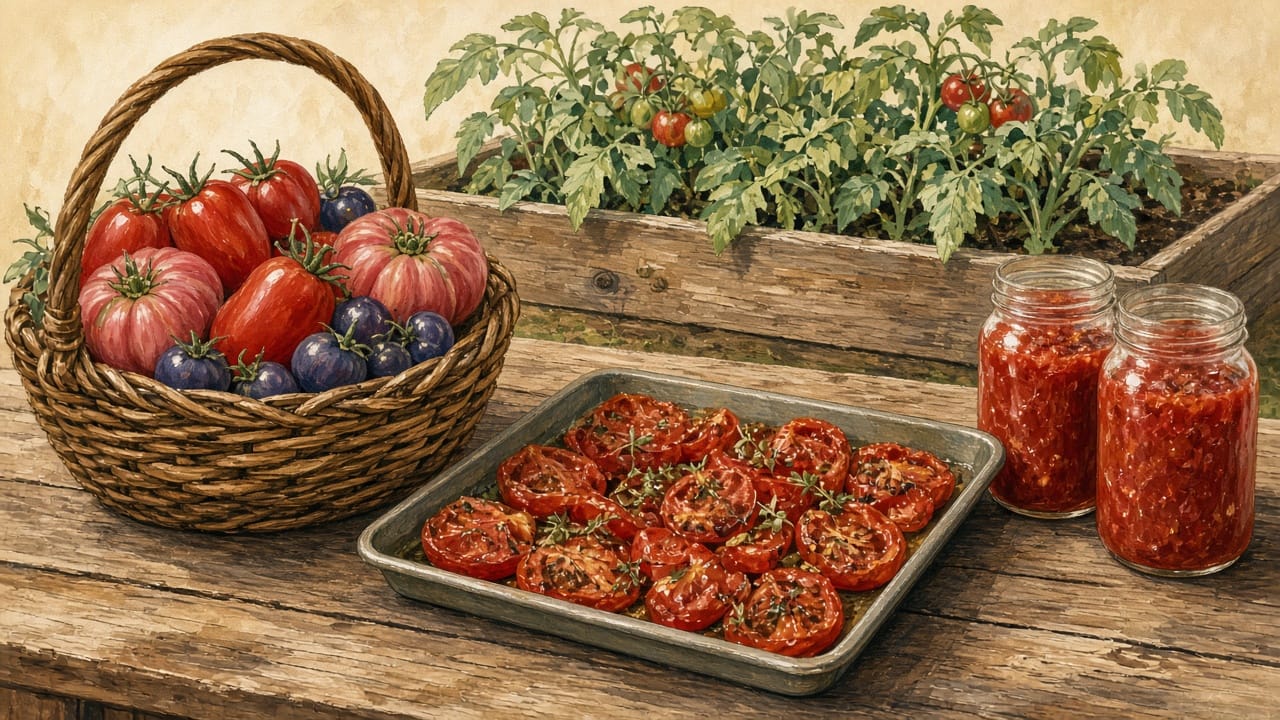
For canning from small beds, grow a paste-type tomato first (a Roma type is the classic), add one or two flavor tomatoes for variety, and plan to acidify and process everything with a tested recipe. Below: how each type behaves in the jar, what determinate and indeterminate mean for a small bed, and the safety rules that matter more than the variety.
Quick answer: what should I plant?
- Thick sauce or salsa with the least fuss: a paste tomato such as a Roma type. NCHFP says paste tomatoes have firmer flesh and make thicker salsa.
- Tight bed, one big harvest: a determinate (bush) paste tomato. Seed companies list these at about 18 to 24 inches apart.
- Steady picking all season, and you can trellis: an indeterminate variety, spaced about 24 to 36 inches apart.
- Sweetness: cherry tomatoes. They’re much sweeter, but treat them as a flavor add-in, not your main canning crop.
- Safety, whatever you grow: add bottled lemon juice or citric acid, and use a tested recipe exactly as written.
Varieties at a glance
These are varieties I've grown and canned. Days to maturity come from the seed companies' own pages and are research, not my results.
Gladiator Roma. A large-fruited Roma type that I've grown and canned. I don't know which seed company my seed came from, so I'm not listing days to maturity or habit for it.
Ozark Pink. Baker Creek lists it as indeterminate, 65 to 75 days. I've grown and canned it.
Midnight Snack. Harris Seeds lists it as an indigo-type cherry tomato, indeterminate, 70 days. I've grown it, and it's very sweet.
Nova. Territorial lists it as determinate, 65 days. I haven't grown this one.
The "See ... page" links go to the seed company's own site and are not affiliate links. Where a "Check seed prices" button appears, it is an affiliate link: I may earn a commission at no extra cost to you.
Where I'm coming from
I've been canning for 5 to 10 years and I grow in raised beds. Most of what I put up is tomatoes and salsa, plus pickles and jam, in half-pint and pint jars, using a boiling-water canner. I've grown and canned Roma, Gladiator Roma, cherry tomatoes (including Midnight Snack), Ozark Pink, and heirlooms from Baker Creek seeds. All of them can well.
Everything marked as research comes from NCHFP/USDA or seed company pages, linked at the end. I'm a home canner, not a food-safety professional.
Paste vs slicing vs cherry tomatoes for canning
Paste (Roma types). Research: NCHFP’s salsa guidance says paste tomatoes, such as Roma, have firmer flesh and make thicker salsas than large slicing tomatoes. Its Tomato Salsa with Paste Tomatoes recipe notes that slicing tomatoes need a much longer cooking time to reach a good consistency. My experience: Roma and Gladiator Roma (a large-fruited Roma type) both canned well for me.
Slicing and heirloom. Research: NCHFP says slicing tomatoes usually give a thinner, more watery salsa, though both types make good salsa. My experience: Ozark Pink and the Baker Creek heirlooms I’ve grown all canned well too.
Cherry. My experience: cherry tomatoes, including Midnight Snack, are much sweeter than the others. Research: I couldn’t find an NCHFP tested recipe written for cherry tomatoes. Tested recipes call for peeled, cored, chopped regular tomatoes, so don’t swap cherries into one.
One more NCHFP rule for every type: use firm, high-quality, disease-free tomatoes, and never use fruit from dead or frost-killed vines.
Determinate vs indeterminate in small raised beds
Research: Baker Creek describes determinate tomatoes as growing, flowering and setting fruit, then stopping. Indeterminate ones keep growing and fruiting until frost. Territorial says determinates grow compactly, usually need no staking, and ripen fruit over a short period.
| Determinate (bush) | Indeterminate (vining) | |
|---|---|---|
| Harvest | One big flush | Steady picking until frost |
| Space (Territorial) | 18 to 24 inches apart | 24 to 36 inches apart |
| Support | Often little; Baker Creek says light support helps | Stakes, cages or a trellis |
| Good for | One big canning day | Fresh eating plus a trickle for jars |
| Examples on this page | Nova (Territorial) | Midnight Snack (Harris Seeds), Ozark Pink (Baker Creek) |
In a small bed, a determinate paste tomato fits more plants and gives you a batch at once. An indeterminate plant gives you more over time but needs a trellis and pruning. Baker Creek recommends trellising because it keeps fruit off the ground and improves airflow.
Days to maturity (from seed company pages)
Companies count days differently, so treat these numbers as a guide.
| Variety | Company page | Habit | Days listed | Spacing listed |
|---|---|---|---|---|
| Ozark Pink | Baker Creek | Indeterminate | 65 to 75 | 24 inches |
| Midnight Snack (indigo-type cherry, F1) | Harris Seeds | Indeterminate | 70 | 12 to 36 inches in the row |
| Martino’s Roma (a Roma-type example) | Baker Creek | Determinate | 70 to 80 | 24 inches |
| Nova (research pick) | Territorial | Determinate | 65 | 18 to 24 inches |
I haven’t grown Martino’s Roma or Nova. I’ve grown Gladiator Roma but don’t know which seed company mine came from, so it isn’t in the table. Check your own packet for its days and habit.
Disease resistance and healthy plants
NCHFP wants disease-free fruit, so healthy plants are a canning issue, not just a garden one. Research: Baker Creek describes Ozark Pink as bred for heat, humidity and disease resistance, and lists early-blight resistance for Martino’s Roma. Cornell’s variety database lists Ozark Pink with resistance to Verticillium and Fusarium wilt. Baker Creek’s advice is crop rotation, watering at the base instead of the leaves, and spacing for airflow.
Safety first: acid, proportions and tested recipes
- Tomatoes sit near the acid line, so add acid. NCHFP says to add 2 tablespoons of bottled lemon juice or 1/2 teaspoon of citric acid per quart, or 1 tablespoon or 1/4 teaspoon per pint. Vinegar (4 tablespoons of 5% per quart) works but can change flavor. This applies even when you pressure can.
- Use bottled juice labeled “from concentrate.” NCHFP says juice that is not from concentrate has no guaranteed acidity, and fresh-squeezed juice should never be substituted. Bottled lemon juice or citric acid is cheap insurance.
- Don’t change the proportions in a salsa recipe. NCHFP says the only safe change in its Tomato Salsa with Paste Tomatoes is the amount of spices and herbs. Don’t alter the proportions of vegetables to acid and tomatoes. Don’t increase the total peppers. You may swap one type of pepper for another. Don’t substitute vinegar for lemon juice.
- Use a tested salsa recipe. NCHFP’s Choice Salsa is built for choice: you can use various tomatoes, peppers and onions, but you must keep the tested proportions and measure level. It requires peeled, seeded tomatoes and bottled lemon or lime juice.
- Don’t thicken with flour or cornstarch before canning. NCHFP says to thicken after opening the jar instead.
- Be careful with thick or blended products. NCHFP’s heat-processing backgrounder says heat travels more slowly through thick, puréed or mashed food than through pieces in liquid. If a process isn’t calculated for that style of pack, the food may be underprocessed. It says current USDA recommendations don’t include puréed vegetables, and that using a process time meant for pieces in liquid on a purée puts you at great risk for botulism.
What I take from that: for a thick salsa, pick a tested recipe that makes it thick, such as the Tomato/Tomato Paste Salsa. For a thick, blended style no tested recipe covers, freeze it or refrigerate it. Jars, lids and a food mill are covered in my starter-kit guide. With acid added, tomatoes can go in either canner (see which canner you need), and my pressure canner picks are optional for tomatoes.
How I do it (personal experience, not a recipe)
This is what I do in my own kitchen. It describes my habits. It is not a tested recipe, and it is not instructions for you. For acid, proportions and processing times, follow the NCHFP recipe as written.
- Cherry tomatoes and Midnight Snack: I oven-roast them and blend them in a Vitamix. Midnight Snack is very sweet, and roasting and blending it gives a thicker, pastier salsa.
- Roma, Gladiator, Ozark Pink and the heirlooms: I roast them, remove the skins, then blend for the salsa base.
- Skins: I’ve canned with skins on and off. Skins left in (if you don’t blend to a paste) show up in the salsa and can feel harder and flaky. I prefer peeled.
- Peppers: I peel and deseed them.
- Washing (my habit): I wash produce in baking soda water, then give it a final rinse in vinegar water. I throw out fruit that is rotten, dead or damaged. I’m not claiming this removes pesticides, dirt or germs. It’s just my routine. Research: FDA advises washing produce under running water, says washing can reduce bacteria but will not eliminate it, and says to throw away produce that looks rotten (FDA). FDA does not recommend soap, detergent or commercial produce washes, and FoodSafety.gov says vinegar and lemon juice have not been shown to be effective at removing germs on produce (FoodSafety.gov). I haven’t seen either agency address baking soda water, so my routine is my own habit, not something those pages back up.
- Roasting: I roast everything except the onions at 375°F, sometimes 400°F, for at least 20 to 40 minutes depending on the size of the pieces. I’m not claiming the roasting makes the salsa safer.
- Garlic: I sometimes roast garlic with the rest. I also use minced garlic from a jar (the refrigerated kind). I add it to the Vitamix right as the roasted vegetables come out of the oven, so the blend is roughly 375°F hot. That temperature is my estimate, not something I’ve measured.
- Jars and the water bath: I pour the blend into jars and process them in a boiling-water bath for 20 to 30 minutes. That time is what I do. It is not a tested process time for this style of salsa.
- Bottled lemon juice: I also add bottled lemon juice, along with the vinegar below. That is my home practice too, not a tested amount.
- Vinegar (my habit, not a recommendation): I add about a tablespoon of vinegar per batch, sometimes two, for example to roughly half a Vitamix of salsa. This is just a home habit. It is not a tested or measured amount, and it is not a substitute for the acid in a tested recipe. Please don’t copy it as a safety measure. For acid and processing, follow the NCHFP tested recipe as written.
- My styles: spicy, thick, and what I feel is gentler on digestion. That last point is my own personal observation. It’s not medical advice or a health claim.
Research on tradition: in Italian cooking, peeling and often deseeding tomatoes for passata is a long-standing tradition, done for a smooth texture. I mention it as a tradition, not as a health claim.
Please read this before you copy anything above. My routine is my own home practice. It is not a tested recipe, and I'm not calling it safe, validated or sterilizing. My washing and roasting are not safety steps, and I'm not claiming any health or safety benefit from them.
- Thick, pureed salsa heats slowly in the jar. NCHFP's heat-processing backgrounder says heat moves more slowly through thick, puréed or mashed food than through pieces in liquid. So the process times and acid amounts in tested salsa recipes cannot be assumed to apply to a roasted, blended salsa like mine.
- A hot blend or a splash of vinegar does not replace tested processing. Pouring a hot blend into jars, or adding a tablespoon of vinegar, is not a substitute for a recipe that was tested for its ingredients, acid and jar size.
- Garlic and other add-ins matter. The NCHFP salsa recipes are tested with set amounts of vegetables, including garlic (for example, 6 cloves of finely chopped garlic in Tomato Salsa with Paste Tomatoes). That recipe says "The only change you can safely make in this salsa recipe is to change the amount of spices and herbs. Do not alter the proportions of vegetables to acid and tomatoes because it might make the salsa unsafe." NCHFP's Ingredients for Salsa Recipes page says to use the amount of each vegetable listed and the amount of vinegar or lemon juice listed, that you may change the amount of spices, and not to can salsas that don't follow tested recipes (they may be frozen or refrigerated). I did not find NCHFP guidance on jarred or roasted garlic, so I can't tell you either one is interchangeable with the fresh garlic in a tested recipe. Treat extra garlic or other low-acid add-ins as changes the tested recipes don't cover.
- What to do instead: use an NCHFP or USDA tested salsa recipe exactly as written, or freeze an untested thick salsa.
My roasted and blended style is not a tested NCHFP recipe. For shelf-stable jars, use a tested recipe as written, and treat freezing as the safer route for untested thick styles.
Frequently asked questions
What is the best tomato for canning?
A paste tomato, like a Roma type, is the easiest choice for thick sauce and salsa because of its firm flesh. Slicing and heirloom tomatoes can be canned too, but expect a thinner product.
Should I grow determinate or indeterminate tomatoes in a small bed?
Determinate plants take less room and ripen over a short window, which suits a big canning day. Indeterminate plants keep producing but need a trellis and more room.
How far apart should I plant them in a raised bed?
Territorial suggests 18 to 24 inches for determinates and 24 to 36 inches for indeterminates. Baker Creek lists 24 inches for the varieties above. Follow your packet.
Do I have to add lemon juice or citric acid?
Yes, in the amount your tested recipe gives. Use bottled juice from concentrate, not fresh or “not from concentrate.”
Can I make salsa thicker before canning?
Don’t add flour or cornstarch. Use a tested recipe that includes tomato paste, or thicken after opening the jar.
Can I can a blended, thick salsa?
Not unless a tested recipe says so. NCHFP says thick, puréed foods heat more slowly and may be underprocessed. Freeze untested thick styles.
The bottom line
Grow a paste tomato for the backbone of your canning, add a flavor tomato or two, and match the habit to your bed. Then let the tested recipe do the safety work: add the acid, keep the proportions, and use the time for your jar size and elevation.
Last reviewed against the sources below on October 17, 2026. Seed details and prices change; this page will be updated.
Keep reading
- Pressure Canner vs Water Bath Canner: Which Do You Actually Need?
- Best Pressure Canners for Beginners (Honest Picks)
- Canning Supplies Starter Kit: What You Need and What to Skip
Sources
- NCHFP, Canning Tomatoes, Introduction and Tomato acidification directions.
- NCHFP, Ingredients for Salsa Recipes, Tomato Salsa with Paste Tomatoes, Choice Salsa and Tomato/Tomato Paste Salsa.
- NCHFP, Standard Tomato Sauce (thin and thick sauce, as tested).
- FDA, Selecting and Serving Produce Safely and FoodSafety.gov, Safe ways to handle and clean produce.
- NCHFP, Backgrounder: Heat Processing of Home Canned Foods.
- NCHFP, NewsFlash on bottled lemon juice from concentrate.
- Harris Seeds, Midnight Snack F1 tomato.
- Baker Creek, Ozark Pink, Martino’s Roma and Tomatoes 101.
- Territorial Seed, Nova.
- Cornell, Ozark Pink, Vegetable Varieties for Gardeners.
- Recipes from Italy, Homemade Tomato Passata (tradition of removing skins and seeds).